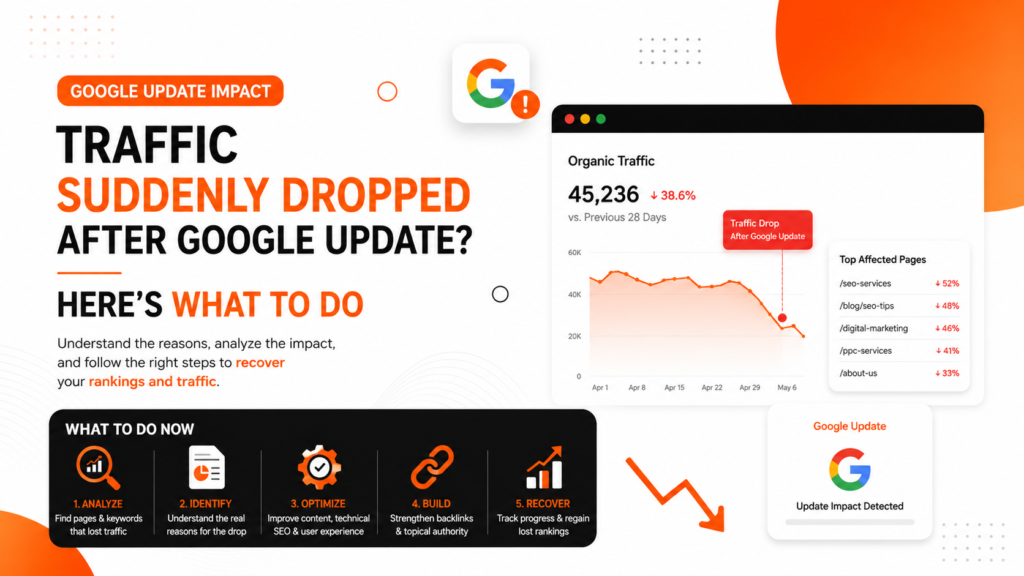
You wake up, open Google Analytics, and suddenly your traffic graph looks completely different.
Leads slow down. Rankings disappear. Calls reduce. Sales drop.
This situation creates panic for many businesses.
A clinic in Delhi may lose local rankings overnight.
An e-commerce website in Mumbai may see product traffic collapse.
A startup in Bangalore may lose blog rankings after months of SEO work.
One of the most common reasons behind sudden SEO traffic loss is a Google algorithm update.
Google releases updates regularly to improve search quality. Some websites gain visibility after updates, while others lose rankings because Google starts evaluating quality signals differently.
The important thing to understand is this:
A traffic drop after a Google update does not always mean your website is penalized.
In many cases, Google simply found other websites more useful, trustworthy, relevant, or technically optimized.
The good news is that recovery is possible if you correctly identify what changed and improve the right SEO areas.
This article explains:
- Why do traffic drops happen after Google updates
- How Google evaluates websites after updates
- Common SEO mistakes causing ranking loss
- Step-by-step recovery strategies
- Long-term prevention tips
- Expert recommendations for sustainable rankings
What a Google Update Traffic Drop Actually Means
Google updates change how rankings are calculated.
These updates may affect:
- Content quality evaluation
- User experience signals
- Search intent matching
- Link quality
- Spam detection
- Local SEO visibility
- Technical SEO interpretation
When traffic drops after an update, Google is essentially reassessing your website against competitors.
This does not always mean:
- Your SEO is completely bad
- Your website is penalized
- Recovery is impossible
It usually means:
- Competitors improved faster
- Your content quality is poorer
- User experience signals are poor
- Technical SEO problems exist
- Search intent alignment is weak
- Website trust signals are insufficient
Why Traffic Suddenly Drops After Google Updates
Thin or Generic Content
One major reason websites lose rankings is low-value content.
Google increasingly rewards:
- Helpful content
- Original insights
- Real expertise
- Strong topical depth
- User-focused information
Websites often lose rankings because they publish:
- AI-generated generic blogs
- Rewritten competitor content
- Thin service pages
- Keyword-stuffed articles
- Duplicate location pages
Example
A digital marketing website in Noida lost rankings after a core update because most blog articles repeated generic SEO advice already available everywhere online.
Meanwhile, competitors published:
- Case studies
- Real examples
- Practical insights
- Updated technical SEO explanations
Google rewarded the more useful content.
Weak EEAT Signals
Google evaluates:
- Experience
- Expertise
- Authoritativeness
- Trustworthiness
This is especially important for:
- Healthcare websites
- Finance websites
- Legal businesses
- SEO agencies
- E-commerce brands
Weak trust signals include:
- No author information
- No business credibility
- No original insights
- Poor reviews
- Thin About page
- Weak backlink profile
Search Intent Mismatch
Sometimes pages rank temporarily but later lose visibility because they do not fully satisfy user intent.
For example:
- Users searching for “best CRM software” expect comparisons
- Users searching for “SEO agency in Delhi” expect service providers
- Users searching “how to improve Core Web Vitals” expect technical solutions
If your page does not match search intent properly, rankings may decline after updates.
Poor Technical SEO
Technical SEO issues often become more visible after Google updates.
Common problems include:
- Slow page speed
- Mobile usability issues
- Broken internal links
- Duplicate pages
- Crawl inefficiencies
- Poor canonical setup
- Weak Core Web Vitals
Google increasingly prioritizes a better user experience.
Toxic or Spammy Backlinks
Some websites lose rankings because of:
- Purchased backlinks
- Spammy guest posts
- PBN links
- Irrelevant directory links
Google updates often target manipulative link-building practices.
Over-Optimized SEO
Some websites become too optimized for search engines instead of users.
Examples:
- Excessive keyword repetition
- Artificial internal linking
- Hidden keywords
- Doorway pages
- Over-optimized anchor text
Google updates frequently reduce rankings for these tactics.
Common Mistakes Website Owners Make After Traffic Drops
Panic Editing Everything Immediately
Many businesses start:
- Changing titles daily
- Removing content
- Rewriting entire websites
- Deleting pages randomly
This often worsens the problem.
First identify:
- Which pages lost traffic
- Which keywords dropped
- Whether the entire site was affected
Use data before making decisions.
Ignoring Google Search Console Data
Google Search Console provides valuable insights about:
- Lost queries
- Dropped pages
- Indexing issues
- Crawl problems
- Core Web Vitals
Many businesses never analyze this properly.
Focusing Only on Backlinks
Not every traffic drop is a backlink problem.
Often the real issue is:
- Weak content quality
- Poor search intent matching
- Thin topical authority
- Weak user experience
Publishing More Low-Quality Content
Some websites respond to ranking drops by publishing large amounts of rushed content.
This usually increases quality problems instead of solving them.
Step-by-Step SEO Recovery Plan
Step 1: Identify What Actually Dropped
Check:
- Which pages lost traffic
- Which keywords declined
- Whether rankings or impressions dropped
- Whether the issue affects desktop or mobile
Use:
- Google Search Console
- Google Analytics
- Ahrefs
- SEMrush
Look for patterns.
Step 2: Compare Competitor Pages
Analyze pages now ranking above you.
Check:
- Content quality
- Topic depth
- Page structure
- Internal linking
- User experience
- EEAT signals
Ask:
“What does Google now prefer that my page lacks?”
This is one of the most important recovery strategies.
Step 3: Improve Content Quality
Update weak pages by adding:
- Real examples
- Expert insights
- Step-by-step solutions
- FAQs
- Updated information
- Better formatting
- Visual explanations
- Statistics
- Case studies
Avoid superficial updates.
Google wants meaningful improvements.
Step 4: Improve Technical SEO
Audit your website for:
- Slow loading pages
- Broken links
- Mobile issues
- Duplicate content
- Crawl problems
- Canonical issues
- Sitemap errors
Technical SEO becomes more important after updates.
Step 5: Improve Internal Linking
Internal links help Google:
- Understand topic relationships
- Prioritize pages
- Distribute authority
Internal Linking Suggestions for WebRise Technologies
You can naturally link this article to:
- SEO Services
- Technical SEO Services
- Website Design Services
- Blog Section
- Local SEO content
This strengthens topical authority.
Step 6: Remove or Improve Weak Pages
Low-quality pages can weaken overall site quality signals.
Review:
- Thin blogs
- Duplicate city pages
- Outdated articles
- Weak service pages
Improve, merge, or remove low-value URLs.
Step 7: Improve User Experience
Google increasingly measures:
- Engagement
- Mobile usability
- Page speed
- Readability
Improve:
- Navigation
- Visual structure
- Mobile responsiveness
- Page loading speed
Step 8: Build Website Trust
Strengthen:
- About page
- Author bios
- Testimonials
- Reviews
- Case studies
- Brand mentions
- High-quality backlinks
Google wants trusted businesses.
Best Tools to Analyze Traffic Drops
| Tool | Purpose |
|---|---|
| Google Search Console | Ranking and indexing analysis |
| Google Analytics | Traffic behavior analysis |
| Ahrefs | Backlink and competitor analysis |
| SEMrush | Keyword tracking |
| Screaming Frog | Technical SEO audits |
| Google PageSpeed Insights | Core Web Vitals analysis |
| GTmetrix | Website speed testing |
Prevention Tips
Focus on Helpful Content
Google increasingly rewards:
- Original expertise
- User-focused content
- Practical problem solving
Avoid publishing content only for rankings.
Build Topical Authority
Create connected content clusters.
Example:
Main Topic
Technical SEO
Supporting Blogs
- Core Web Vitals Fixes
- Indexing Problems
- Canonical Tag Issues
- XML Sitemap Optimization
- Google Search Console Errors
This strengthens authority signals.
Monitor SEO Performance Regularly
Track:
- Rankings
- Clicks
- Impressions
- Crawl errors
- Index coverage
Early detection helps prevent major traffic loss.
Avoid Shortcut SEO Tactics
Do not:
- Buy spam backlinks
- Use keyword stuffing
- Publish mass AI content
- Create doorway pages
Google updates increasingly target manipulation.
Expert Recommendation
Most websites affected by Google updates recover slowly, not instantly.
Recovery usually happens when businesses:
- Improve content depth
- Strengthen trust signals
- Fix technical SEO
- Improve user experience
- Build topical authority
One important observation from recent Google updates is this:
Websites trying to “game SEO” often lose visibility over time.
Websites genuinely helping users usually gain long-term stability.
That difference matters more than ever.
FAQ Section
Why did my traffic suddenly drop after a Google update?
Google updates reassess websites based on quality, relevance, trust, and user experience. Your competitors may now better satisfy search intent or quality standards.
How long does it take to recover from a Google update?
Recovery can take weeks or several months, depending on how quickly you improve content quality, technical SEO, and trust signals.
Can AI-generated content cause ranking drops?
Yes, if the content is generic, repetitive, or lacks originality and expertise. Helpful and well-edited AI-assisted content may still perform well.
Should I delete pages after a traffic drop?
Not always. First, identify weak pages. Some pages should be improved, merged, or updated instead of deleted.
How do I know if my website was hit by a Google update?
Check ranking and traffic timelines in Google Search Console and compare them with known Google update dates.
Conclusion
A sudden traffic drop after a Google update can feel frustrating, especially when your business depends on organic leads and visibility.
But most ranking losses are recoverable if you:
- Analyze the real problem carefully
- Improve content quality
- Strengthen technical SEO
- Enhance user experience
- Build stronger trust signals
Google updates are designed to reward websites that genuinely help users.
Businesses focusing on:
- Useful content
- Better SEO practices
- Real expertise
- Strong website quality
…usually build more stable rankings over time.
Need Professional SEO Help?
If your website traffic dropped after a Google update, the experts at WebRise Technologies can help identify the real cause and create a practical SEO recovery strategy.
Our services include:
- Technical SEO audits
- Google update recovery analysis
- Content optimization
- Local SEO improvements
- Core Web Vitals optimization
- WordPress SEO fixes
- Ranking recovery strategies
Contact WebRise Technologies today to recover your rankings, improve visibility, and grow your organic traffic with expert SEO solutions.